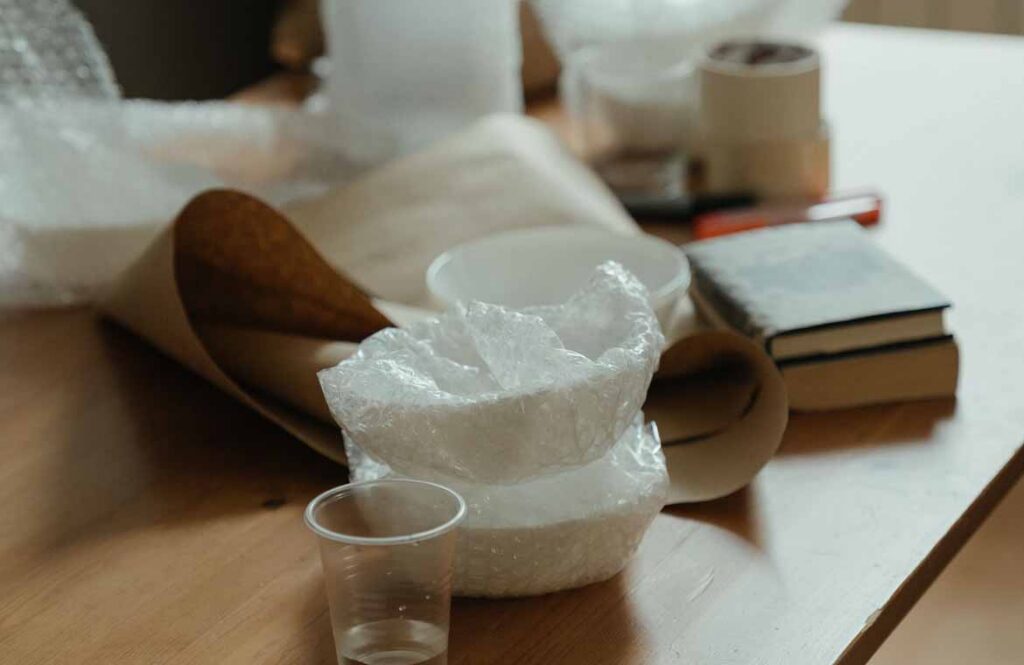
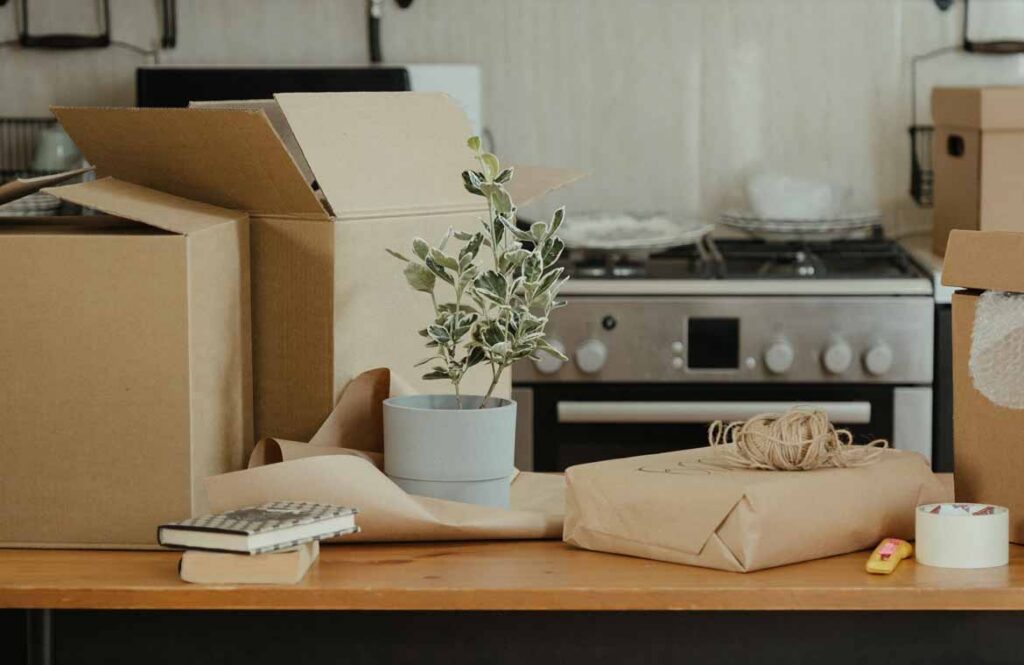
Ask any moving crew which room decides whether a move runs well and they will all say the kitchen. It holds more individual objects than any other room in the house, most of them heavy, fragile, sharp or perishable, and it is the one room you cannot pack early because you need it right up until the last morning.
It is also where nearly every damage claim comes from. Not because kitchens are hard, but because people leave them until the final night and then work fast in the dark.
This guide is the whole job, in the order you should actually do it. Each zone links through to a full deep-dive article where there is more to say than fits here, so use this as the map and follow the links when you get to the detail.
How to pack a kitchen for moving: the short version
- Three weeks out, declutter. The kitchen holds more dead weight than any other room.
- Buy supplies in one go. Small boxes, lots of paper, more tape than you think.
- Start running the pantry and freezer down at the same time.
- Pack in zones, least-used first. Special occasion china before everyday plates.
- Plates travel on their edge, never stacked flat. The single most important technique in the room.
- Glasses go upright, paper inside and out.
- Everything heavy goes in a small box. Keep every carton under about 16 kg.
- Set aside what your movers can’t legally carry: oils, aerosols, cleaning chemicals, gas bottles, anything perishable.
- Pack an OPEN FIRST box last and carry it in your car.
How long a kitchen actually takes
Everyone underestimates this. A kitchen is not an evening.
| Kitchen | Packing it yourself | Two professional packers |
|---|---|---|
| Apartment or small galley | 3–4 hours | ~1 hour |
| Standard family kitchen | 6–8 hours | 1.5–2 hours |
| Large kitchen with butler’s pantry | 10–14 hours | 2.5–3.5 hours |
Roughly 45% of that time goes on crockery and glassware, 30% on pots, pans and appliances, 15% on the pantry, and the last 10% on cutlery, utensils and the drawer nobody can name.
Plan it as two sessions across two days rather than one long night. Fatigue is what causes the mistakes.
How many boxes a kitchen needs
More small boxes than anywhere else in the house, because almost everything in a kitchen is dense.
| Kitchen | Small (book cartons) | Medium | Large |
|---|---|---|---|
| Small | 6–8 | 3 | 1 |
| Family | 12–15 | 6 | 2 |
| Large | 20–25 | 10 | 3 |
Also budget a full ream of butcher’s paper for the kitchen alone, plus a divider insert if you own stemware. Full materials list and current New Zealand prices are in our packing supplies checklist.
Three weeks out: the sort
Kitchens accumulate. There is a sandwich press behind the slow cooker, a set of ramekins used once, and a drawer of takeaway sauce sachets that has achieved sentience.
Empty one cupboard at a time onto the bench and apply one test: have I used this since the last time I moved? If not, it does not deserve a box, a truck, or space in the new place.
Three destinations. Sell or donate anything working and useful. Bin anything chipped, warped, missing a lid or coated in something that will not come off. Keep the rest, and be honest about the difference between “I use this” and “I own this”.
Unopened, in-date food goes to a foodbank rather than the bin. There is more on that, including what New Zealand food rescue organisations will and will not take from households, in our guide to packing pantry food when moving house.
Do this three weeks out, not on packing day. Decluttering and packing at the same time is how a four-hour job becomes a ten-hour one.
The order to pack in
Work from least-used to most-used, so the kitchen stays functional as long as possible. In practice that means eight zones, in this order:
- Special occasion crockery, serving dishes, the good glasses
- Bakeware, spare containers, appliances you use monthly
- Cookbooks, vases, decorative bits
- Everyday glassware
- Pots, pans, casserole dishes
- Everyday crockery, down to two plates and two bowls per person
- Pantry dry goods
- Knives, cutlery, the kettle, the last pan, the fridge
Zones one to three can go three weeks out. Four and five in the final week. Six, seven and eight in the last two or three days. It sounds fussy and it is the difference between eating properly all week and living on takeaways.
Zone 1: crockery, plates and bowls
The biggest single job in the kitchen and the one with the most breakage.
The rule that matters: plates travel standing on their edge, like records in a crate, never stacked flat. A plate is strong across its face and weak across its middle, so a flat stack puts the whole load on the bottom plate at whatever point is not perfectly level, and road vibration finishes the job.
Wrap each plate individually in packing paper, bundle three or four of the same size together, wrap the bundle again, and stand the bundles upright in a book carton lined with crumpled paper. Fill every gap. Bowls get a sheet of paper between each one if you nest them. Mugs need a ball of paper inside and extra wrapping around the handle, which is the part that always goes.
The full method, including the double-box technique for inherited china and what to do about opened packets of unmatched dinner sets, is in how to pack dishes and plates for moving.
Zone 2: glassware and stemware
More fragile than crockery, but easier to protect, because the strongest position is also the natural one.
Paper inside the bowl of the glass first so the walls cannot flex, then wrap the outside. Every glass stands upright on its base, which is the thickest part. Never lay a glass on its side.
Stemware needs the stem wrapped separately in bubble wrap before the glass is wrapped, because a stem snaps under almost no sideways pressure. If you own more than a few, buy a cell carton with cardboard dividers. It is about fifteen dollars and it is the difference between arriving with a set and arriving with most of a set.
Zone 3: pots, pans and bakeware
Heavy, awkward, and usually packed badly because they seem indestructible. They are not: non-stick coatings scratch, cast iron chips enamel, and a stack of pans grinding against each other for an hour does real damage.
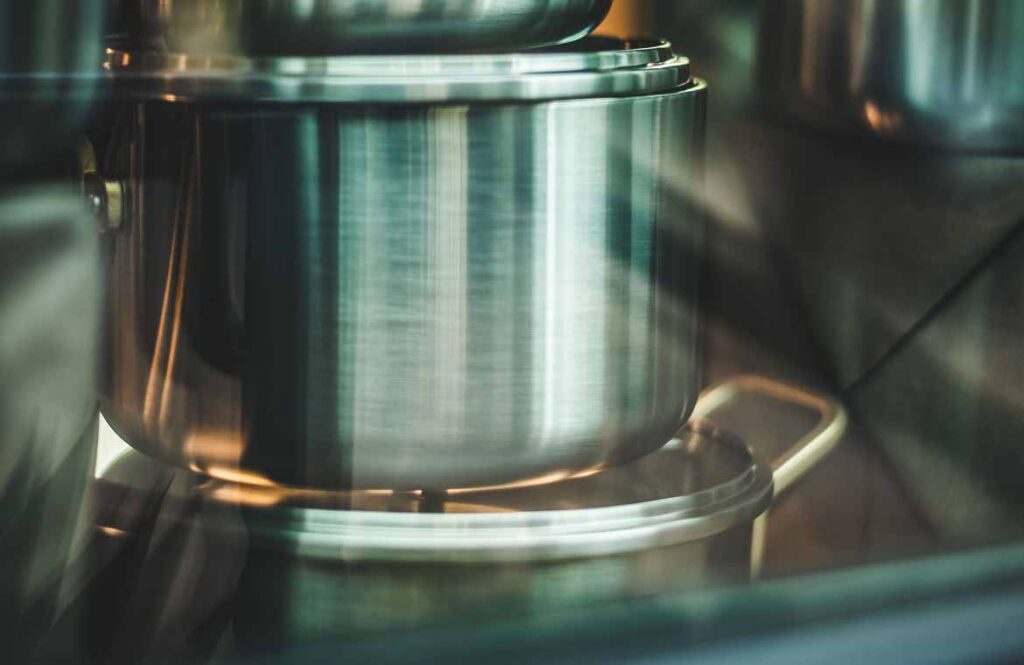
Nest them, with paper between each one. Two or three pans inside the largest, a sheet of paper or a tea towel between every layer. Lids come off and get wrapped separately, or laid flat on top of the nest.
Cast iron gets its own space. A cast iron pan in a box of lighter cookware is a wrecking ball. Wrap it, put it at the bottom of a small carton, and build around it.
Handles are the problem. Long pan handles stick out and puncture box walls. Pack handles pointing into the centre of the box, alternating direction so they interlock rather than all pushing one wall.
Bakeware travels on edge like plates. Baking trays, oven dishes and cake tins stacked flat with paper between them are fine too, but on edge is better and uses less space.
Take the opportunity to wipe everything down. Baked-on grease attracts pests in a box that might sit for a few days.
Zone 4: knives and anything sharp
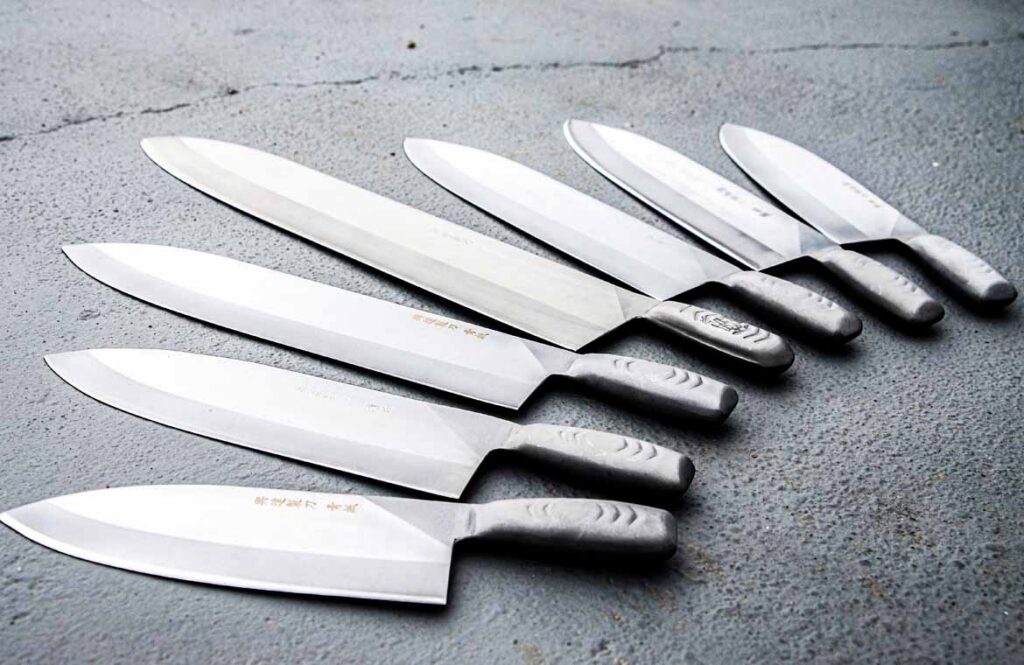
This is the one part of the kitchen that can genuinely hurt someone, and it takes two minutes to do properly.
Wrap each blade in several layers of paper, then fold a piece of cardboard over the cutting edge and tape it in place. Bundle the wrapped knives together, tape the bundle, and write KNIVES on the outside of the bundle itself, not just the box. The person who opens that box may not be you, and they will be reaching in blind.
A knife block can travel with the knives still in it if you stretch wrap the whole thing so nothing can slide out. That is the easiest option if you own one.
The same treatment goes for mandolines, box graters, food processor blades, skewers and kitchen shears. Food processor blades in particular end up loose in the bottom of a box more often than anything else, so bag them and tape the bag to the appliance they belong to.
Mark the box SHARP as well as FRAGILE, on the top and two sides.
Zone 5: small appliances and electronics
The bench appliances are worth more than most people realise. A coffee machine, a stand mixer and a decent air fryer together can exceed a thousand dollars.
Two things actually go wrong, and neither is impact. The first is water left inside something: a coffee machine with a half-full reservoir leaks into its own electronics, and a kettle with a cupful in it grows mould over a long weekend. Empty and dry everything three days ahead, drip trays and filters out on the bench.
The second is cables. Never make a communal cable box. Every cable gets coiled loosely, secured with a velcro strap, and sealed in a labelled bag taped to its own appliance.
Original boxes beat anything you can buy. Otherwise wrap in two or three layers, pack upright in a small carton, and fill the gaps. There is considerably more on this, including the condensation trap that catches people out in a New Zealand winter, in how to pack small appliances and electronics for moving.
Zone 6: the pantry
Start running it down six weeks out. Stop buying anything that is not fresh and build meals from what is on the shelves. Most households can eat for a fortnight out of the pantry without noticing, and every kilogram you eat is a kilogram nobody carries down your steps.
What does travel gets bagged: every opened packet sealed inside a resealable bag, flour and sugar double-bagged because paper sacks split, and cling film under the lid of anything liquid before the lid goes back on.
What does not travel is a longer list than people expect, and it is covered in the next section. The full pantry method, including where to donate food in New Zealand and how not to move pantry moths into your new house, is in how to pack pantry food when moving house.
Zone 7: the fridge and freezer
Run the freezer down for two weeks. This is the part of the kitchen that cannot be solved on the day.
For a local move, frozen food is its own ice: pack it tightly into a chilly bin straight from the freezer, keep the lid shut, and put it in your car. Chilled food goes in a second bin with ice packs. Perishable food should not sit in the 5°C to 60°C range for more than two hours, and on a summer moving day in a hot car that clock runs faster than you would like.
Defrost and drain the fridge and freezer at least 24 hours before the move with the doors propped open to dry. If the appliance itself is moving, remember that a fridge laid on its side needs to stand upright for at least as long as it was down before you switch it on, and a full day is the safe answer.
Zone 8: cutlery, utensils and the junk drawer
Cutlery can stay in its tray if you stretch wrap the whole tray, which is the fastest option in the entire kitchen. Otherwise bundle it by type and bag it.
Utensils, spatulas and wooden spoons go in a medium carton or, better, inside a stockpot you are packing anyway. Every empty vessel in a kitchen is a box you do not have to buy.
The junk drawer gets tipped into a resealable bag, sealed, and labelled JUNK DRAWER. Do not sort it now. Sort it in the new house, or more realistically, in about four years.
What your movers legally cannot carry
This surprises almost everyone, and it is better to find out three weeks early than on the morning.
New Zealand removals companies operate under dangerous goods rules and their transit cover is written around them. The standard industry position is that only dried, canned or sealed-packet food goes on the truck. Fresh, chilled and frozen food does not. Beyond that, movers will not carry:
- Cooking oil. A genuine surprise for most people, but it is a spill risk and it ruins everything it touches.
- Aerosols of any kind, including cooking spray and oven cleaner.
- Bleach, ammonia and liquid chlorine, plus concentrated cleaning solvents.
- Methylated spirits, turpentine and firelighters.
- LPG bottles, unless completely empty, purged and certified by a gas testing station.
None of this is a company being awkward. An unsecured drum of oil in a moving truck is a real hazard and no insurer covers a load contaminated by one. Set these aside early, in a crate, upright, for your own vehicle. If you are unsure about something specific, ask when you book or check our moving FAQs.
The cupboard under the sink
Worth its own mention because it is the single most-forgotten part of the kitchen, and almost everything in it is on the list above.
Empty it at the same time as the pantry. Anything half-used and cheap to replace is not worth moving. Anything you are keeping goes in a sealed plastic crate, upright, in your car, never in a cardboard box with anything else. One leaking bottle of bleach will destroy a carton of linen and everything near it.
Take the rubbish bin, the dish rack and the cleaning caddy too. They always get left behind, and you will want them within an hour of arriving.
Box weight and labelling
Keep every kitchen carton under about 16 kg. A book carton of tins or crockery reaches that in one layer, so use small boxes and do not fill them to the top. If you cannot lift it comfortably one-handed under the base, repack it.
Label the top and at least two sides. A label only on the lid is invisible the moment another box stacks on it. Write the room, the contents in three words, and add FRAGILE and THIS WAY UP where they apply. Number every box and keep a running note on your phone, so you can find the coffee plunger on day one without opening fourteen cartons.
The OPEN FIRST box
The last thing you pack and the first thing you open. Kettle, two mugs, teabags, instant coffee, long-life milk, a tin opener, a sharp knife, one pan, salt, dish liquid, a cloth, a roll of paper towels, and snacks for whoever is helping.
Write OPEN FIRST on all four sides and carry it in your car, not the truck. Nobody wants to be excavating cartons at 8pm looking for the teabags.
One thing about self-packed boxes and insurance
Across the New Zealand removals industry, transit cover distinguishes between cartons packed by the moving company and cartons packed by the customer, usually recorded as PBO or “packed by owner”. Damage caused by inadequate packing inside an owner-packed box is a standard exclusion, and the kitchen is where that bites hardest.
Pack carefully using the methods above and you will be fine for everyday crockery. For inherited china, crystal or an expensive coffee machine, having it packed professionally is the cleaner answer. Our Auckland packing service can do the whole house or just the kitchen, which is the option most people actually take, and it is the single room where paying someone makes the most sense.
Boxes: where to get them
Mitre 10 and Bunnings stock everything and are open seven days. Packaging suppliers work out cheaper per unit once you are buying thirty or more. For free cartons, Trade Me and local community pages are full of people offloading boxes the week after their own move, and Packaging Recyclers in Auckland sells used ones cheaply.
Most movers carry cartons too. We can bring materials with us, and in the Franklin and Pukekohe area Movers Pukekohe supply packing materials as part of a booking.
Avoid supermarket produce boxes: no lids, often damp from a chiller, and shapes that will not stack in a truck. Liquor store boxes are the exception and are genuinely excellent, because they are strong and frequently have dividers built in.
If you are moving out of Auckland
Distance changes the calculation. A run across town is a few hundred road bumps. Auckland to Tauranga, Hamilton or Wellington is several hours of continuous vibration plus loading and unloading at both ends, and sometimes a night in a depot.
For those moves: double-box the china, keep fragile cartons well under the weight limit, empty the freezer completely rather than trying to keep it cold, and tell your crew which boxes are kitchen so they load high and last. Our intercity moving service covers Auckland to anywhere in New Zealand, and if you are comparing options for a long-distance run it is worth reading how other operators structure it too, such as this guide to long distance intercity movers and the North Island routes they cover.
Beyond the kitchen
Once the kitchen is done the rest of the house is comparatively easy, with two exceptions. Anything living needs its own plan, and if you keep fish, start reading well before moving week: our guide to moving a fish tank covers why a tank must never be lifted with water in it. For the overall timeline, the Auckland moving checklist maps the eight weeks before moving day.
Frequently asked questions
How long does it take to pack a kitchen?
Six to eight hours for a standard family kitchen if you are doing it yourself, three to four for a small apartment kitchen, and ten to fourteen for a large kitchen with a butler’s pantry. Two professional packers do the same job in roughly a quarter of the time. Split it across two days rather than doing it in one night.
How many boxes do I need for a kitchen?
A family kitchen needs around 12 to 15 small book cartons, 6 medium and 2 large, plus a full ream of butcher’s paper. Kitchens need far more small boxes than any other room because almost everything in them is dense.
What is the best box for packing a kitchen?
The book carton, which is the smallest standard moving box, for anything heavy or fragile. Overseas guides call the equivalent a dish pack or dish barrel; in New Zealand you want a book carton, plus a cell carton with dividers if you own stemware.
Should I use newspaper to wrap dishes?
Not directly against them. Newsprint ink transfers onto glaze and you will spend your first week in the new house washing everything. Use clean packing paper or butcher’s paper against the item, and keep newspaper for filling gaps. Tea towels, linen and clothing also work and cost nothing.
How do I pack kitchen knives safely?
Wrap each blade in several layers of paper, fold cardboard over the cutting edge and tape it, then bundle the wrapped knives and write KNIVES on the bundle itself as well as the box. A knife block can travel intact if you stretch wrap it so nothing slides out. Mark the carton SHARP as well as FRAGILE.
How do I pack pots and pans?
Nest them with a sheet of paper or a tea towel between each one, wrap lids separately, and pack handles pointing into the centre of the box so they do not puncture the walls. Cast iron gets wrapped and placed at the bottom of its own small carton, because in a mixed box it behaves like a wrecking ball.
What is the most common kitchen packing mistake?
Stacking plates flat. It feels natural and it is the single biggest cause of broken crockery, because the bottom plate carries the whole stack on whichever point is not level. Plates go in standing on their edge. The second most common mistake is a half-full box, which lets everything inside move.
Will movers pack my kitchen for me?
Yes, and the kitchen is the room most people choose when they only want partial packing. Swift Movers charges $110/hr for two movers and a truck plus a $50 callout, with no minimum hours, and packing can be booked as part of the move or as a separate visit beforehand.
Can movers take food and cleaning products?
Only dried, canned or sealed-packet food. No fresh, chilled or frozen food, and no cooking oil, aerosols, bleach, solvents, methylated spirits or LPG bottles. Those all travel in your own vehicle, upright and crated.
When should I pack the kitchen?
Last. Start the declutter three weeks out and pack the least-used zones then, but leave everyday crockery, pots, knives and the pantry until the final two or three days. Set aside a small “last box” of essentials you keep using until the morning of the move.
Moving in Auckland? We will pack the kitchen
Swift Movers handles house moving across Auckland seven days a week, 7am to 7pm, and moves nationwide. Two movers and a truck at $110/hr with a $50 flat callout, no minimum hours. Packing can be booked for the whole house or just the kitchen.
We cover North Shore, West Auckland, Central, East, South Auckland, the Hibiscus Coast, Rodney and Franklin, with apartment moves, same-day moves, single item moves and a seniors moving service for anyone downsizing. If money is tight around the move, our WINZ movers Auckland page explains how quotes work for that.