Broken crockery is the most common damage claim on any moving day, and it’s almost always avoidable. Plates don’t break because a mover dropped the box. They break because they were stacked flat, the box was half empty, and 40 kilometres of Auckland motorway did the rest.
Learning how to pack dishes and plates for moving takes about ten minutes and saves you a bin liner of broken china. There’s also a detail most people find out too late: if you packed the box yourself, your mover’s transit cover probably won’t pay for what’s inside it. More on that below, because it changes how carefully you’ll want to do this.
How to pack dishes and plates for moving: the short answer
- Use small boxes. A book carton, not a tea chest. Crockery is heavy.
- Line the base with 5 cm of crumpled paper.
- Wrap every plate individually in packing paper. No shortcuts, no pairs.
- Bundle three or four wrapped plates together and wrap the bundle again.
- Stand the bundles on their edge, like records in a crate. Never stack flat.
- Fill every gap with crumpled paper, tea towels or clothing.
- Shake the box gently. If you hear anything move, open it and add more filler.
- Label it FRAGILE on the top and two sides, plus THIS WAY UP and the room it belongs in.
The one rule: plates travel on their edge
If you take nothing else from this page, take this. Plates go into the box vertically, standing on their rims, the way records sit in a crate.
A plate is strong across its face and weak across its middle. Stack ten plates flat and the bottom one carries the weight of the other nine, concentrated on a single point wherever the stack isn’t perfectly level. Add road vibration for an hour and that plate cracks. Stand the same ten on edge and the load runs through the strongest axis of each plate, with the neighbouring plates supporting it on both sides.
It feels wrong the first time. Do it anyway. It is the single biggest difference between a box that arrives intact and one that rattles.
What to wrap with
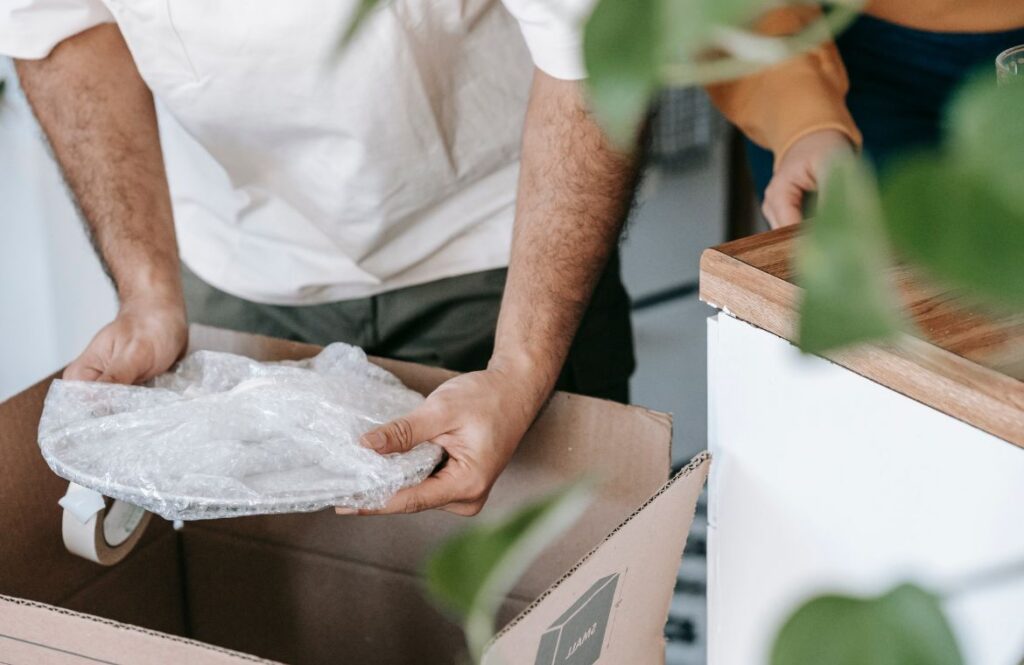
Packing paper is the right first layer. It’s clean newsprint with no ink, it grips the surface so plates can’t slide against each other, and it crumples into filler when you’re done. Buy more than you think you need: a standard kitchen eats a full ream.
Bubble wrap goes on the outside of a bundle, not against the china. Held tight against a glazed or gilded surface for a week in storage, it can leave pressure marks.
Newspaper works as filler and as an outer layer, but the ink transfers. Never put it directly against crockery you care about.
Tea towels, linen and clothing are the free option, and they work. If you’ve run out of paper at 10pm the night before, wrap plates in tea towels and pad the gaps with jumpers. You’re moving the linen anyway, so it costs you nothing and saves a box. The only rule that never bends is that every item gets wrapped individually.
Which boxes to use
Moving-box names in New Zealand aren’t obvious if you haven’t moved recently:
- Book carton is the smallest standard box, and it’s the right one for crockery. Americans call the equivalent a “dish pack” or “dish barrel”, which is why you’ll see that term in overseas guides.
- Tea chest is the big one. Fill it with plates and nobody will be able to lift it. Use it for linen, cushions and lampshades.
- Half tea chest sits between the two and suits mixed kitchenware.
- Cell cartons have cardboard dividers built in and are worth buying if you own stemware.
Mitre 10 and Bunnings stock all of these, as do packaging suppliers and self-storage sites. For free boxes, community pages and Trade Me are full of people offloading cartons the week after their own move. Packaging Recyclers in Auckland sells used cartons cheaply.
Avoid supermarket produce boxes. They have no lids, they’ve often been in a chiller so the cardboard is damp and weak, and the odd shapes mean they won’t stack in a truck.
How to pack plates, step by step
1. Line the base
Crumple paper into loose balls and lay 5 cm across the bottom. This is the crumple zone. A flat sheet does nothing.
2. Wrap each plate
One sheet of paper, plate in the centre, fold the corners in over the face one at a time, tuck the last corner under. Two or three seconds each once you find the rhythm.
3. Bundle in threes and fours
Stack three or four wrapped plates, then wrap the whole bundle in another sheet or a length of bubble wrap and tape it closed. The bundle behaves as one solid object, which is much harder to break than four separate ones. Keep sizes together: dinner plates with dinner plates, side plates with side plates. A small plate inside a stack of large ones creates a pressure point.
4. Stand them on edge
Bundles go in vertically, snug against each other, filling the box from one side to the other. Firm, not forced. If you have to shove, take one bundle out.
5. Fill every gap
Down the sides, in the corners, across the top. Crumpled paper, tea towels, a rolled-up apron. Keep going until the box is genuinely full. A half-full fragile box is the most dangerous thing in the truck.
6. Do the shake test
Close the flaps, lift the box, tilt it gently side to side. Silence means you’re done. Any shifting, clinking or rattling means open it and add more filler. Thirty seconds now beats a bin liner of broken china later.
Bowls, mugs and cups
Bowls follow the plate method with one change: if you nest them, put a sheet of paper between each one. Unprotected rims resting on glazed surfaces are what chips bowls. Wrap in bundles of three or four and stand them on edge like the plates.
Mugs and cups break at the handle, which sticks out and catches everything. Stuff a small ball of paper inside each one first so the walls can’t flex, then wrap the outside with extra paper around the handle. Stand them upright, base down, and separate layers with flattened cardboard. Never pack a mug with its handle pressed against another mug.
Glasses and stemware
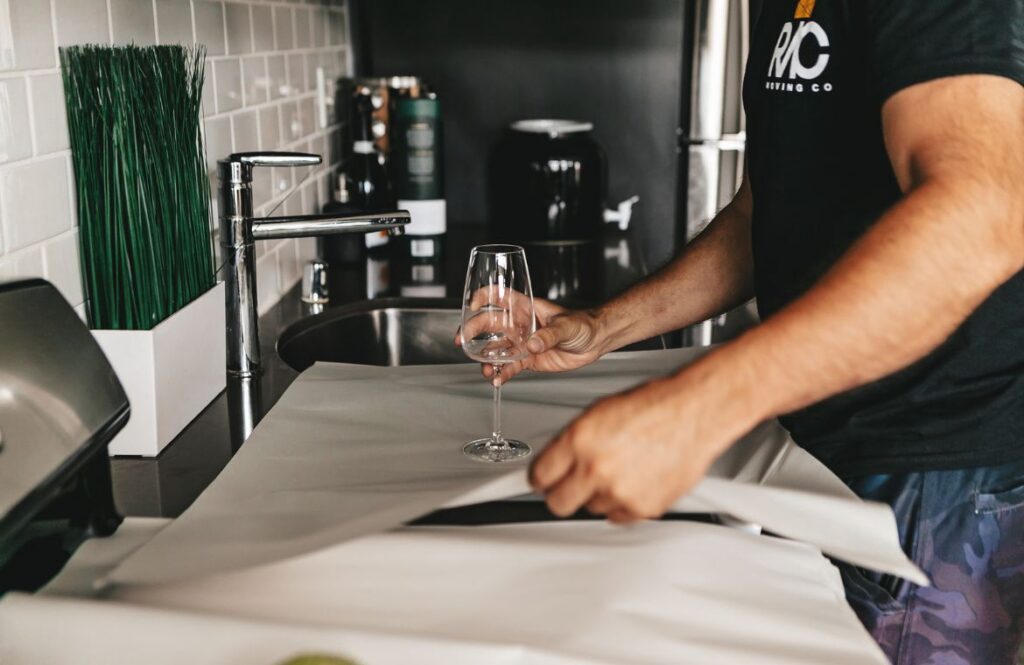
Glasses are more fragile than plates but easier to protect, because upright is both the natural position and the strongest one.
Paper inside the bowl of the glass first, so the walls can’t flex. Then wrap the outside. Stand every glass upright with the base down: the base is the thickest, strongest part of the glass and the rim is the thinnest. Never lay a glass on its side.
Stemware needs more. The stem snaps under almost no sideways pressure, so wrap it separately in bubble wrap before wrapping the whole glass, and give stemmed glasses more room than you think they need. Cell cartons with cardboard dividers are the correct answer here. If you’re stacking two layers, a flat sheet of cardboard between them is essential, and the heavier tumblers go underneath.
China, crystal and things you can’t replace
Inherited dinner sets and wedding crystal get the double-box treatment. Pack them properly into a small box, fill every gap, close it, then sit that box inside a larger one with at least 5 cm of crumpled paper on all six sides. The outer box takes the knock; the inner box never feels it.
Photograph the set before you wrap it. If something does go wrong, a dated photo is the difference between a claim and an argument. Tell your movers which box it is, and it will ride on top of the load rather than under it.
How many plates go in one box?
Count weight, not plates. A box you’ll lift, carry and stack should stay under about 16 kg. In practice that’s a book carton roughly two-thirds to three-quarters full of crockery, which usually works out around 10 to 15 dinner plates depending on how heavy your set is.
The test is simple: pick it up with one hand under the base. If that feels awkward, it’s too heavy. A too-heavy fragile box gets carried badly, put down hard, and stacked in the wrong place.
Labelling, and what never to pack together
Write FRAGILE in large letters on the top and at least two sides. A label only on the lid is invisible the moment another box goes on top. Add THIS WAY UP with an arrow, and the room name so it lands in the right place at the other end.
Four combinations to avoid:
- Books with crockery. Books are dense and they shift. They will find your plates.
- Glasses with plates. Different shapes and weights make it impossible to pack tightly, and tight packing is the whole point.
- Cutlery, knives or tools with breakables. Anything with a point finds the weakest spot.
- Liquids with anything. Oils, sauces and cleaning products go in their own box, bagged, upright.
The part most movers don’t mention: self-packed boxes and your insurance
This is worth knowing before you start.
Across the New Zealand removals industry, transit cover distinguishes between cartons packed by the moving company and cartons packed by the customer, usually written as PBO, “packed by owner”. Damage caused by inadequate packing inside an owner-packed box is a standard exclusion. Some policies extend limited cover to self-packed cartons; others require professional packing for fragile cover to apply at all.
In plain terms: if you pack a box of plates and they arrive in pieces, the usual answer is that the packing failed, not the transport, and the claim doesn’t succeed. It is not a loophole anyone is trying to pull on you, it’s simply that no insurer can underwrite a box they didn’t see packed.
Three sensible responses. Pack it properly using the method above and accept the risk on replaceable crockery. Or have the kitchen packed professionally, which is what our Auckland packing service exists for and what most people choose for china and crystal. Or split the difference and pack the everyday plates yourself while we handle the valuable boxes. Ask us to confirm what your cover includes before moving day, and check the moving FAQs if you want the short version first.
Moving further than across town
Distance changes the maths. A 25-minute run across Auckland is a few hundred road bumps. Auckland to Wellington, or anything crossing Cook Strait, is several hours of continuous vibration plus loading and unloading at both ends, and often a night in a depot.
For those moves, double-box the china, keep fragile cartons well under the weight limit, and tell your crew which boxes are crockery so they’re loaded high and last. Our intercity moving service covers Auckland to anywhere in New Zealand, and long-haul loads get strapped differently for exactly this reason.
When to pack the kitchen
Later than everything else. Set aside a “last box” with a few plates, mugs, glasses and one pan, and pack the rest of the kitchen in the final two or three days. Tape that box shut last and open it first.
If you’re working to a schedule, the kitchen sits in the final week on our Auckland moving checklist. Downsizing and reducing a lifetime of dinner sets at the same time is a bigger job than it looks, and our seniors moving service is built around that pace.
Frequently asked questions
What is the best way to pack plates for moving?
Wrap each plate individually in packing paper, bundle three or four together, wrap the bundle again, and stand the bundles on their edge in a small box lined with crumpled paper. Fill every gap until nothing moves when you shake the box.
Should plates be packed flat or on their side?
On their side, always. Stacked flat, the bottom plate carries the weight of the whole stack on whichever point isn’t level, and road vibration cracks it. On edge, the load runs through each plate’s strongest axis.
Packing paper or bubble wrap for dishes?
Both, in that order. Paper against the crockery because it grips and stops sliding, bubble wrap around the outside of the bundle for impact. Bubble wrap alone lets plates slide, and pressed against glaze or gilt for days it can leave marks.
Can you pack dishes without packing paper?
Yes. Tea towels, linen, socks and clothing all work, and you’re transporting them anyway. Newspaper is fine as filler but the ink transfers, so keep it off anything you care about. What matters is that every item is wrapped individually and no gap is left unfilled.
How many plates should go in one box?
Go by weight. Keep any box you’ll carry under about 16 kg, which is usually 10 to 15 dinner plates in a book carton. If you can’t comfortably lift it one-handed under the base, take some out.
How do you pack glasses so they don’t break?
Paper inside the glass first so the walls can’t flex, then wrap the outside. Stand every glass upright on its base, never on its side. Use a cell carton with dividers for stemware, and wrap stems separately in bubble wrap before wrapping the whole glass.
What is a dish pack?
An American term for a heavy-duty small carton designed for crockery, sometimes called a dish barrel. The New Zealand equivalent is a book carton, or a cell carton if it has dividers.
Do movers pack dishes for you, and what does it cost?
Yes. Swift Movers charges $110/hr for two movers and a truck plus a $50 callout, with no minimum hours, and packing can be booked as part of the move or as a separate visit beforehand. A standard kitchen is usually an hour or two. Get a free quote and say what you’d like packed.
Moving soon? We’ll pack the kitchen
Swift Movers handles house moving across Auckland seven days a week, 7am to 7pm, and moves nationwide. Packing is available on its own, so you can hand over the fragile boxes and keep the rest.
We cover North Shore, West Auckland, Central, East, South Auckland, the Hibiscus Coast, Rodney and Franklin, with apartment moves and same-day moves available.